Case study / OSMI AI

Two products. Four surfaces. 800% token surge at launch.
UX
Product Design
UI
Design System
AI · DePIN · Consumer Tech
Two products. Four surfaces.
800% token surge at launch.

The first AI assistant owned by the people. Marketing site, product, and node sale.

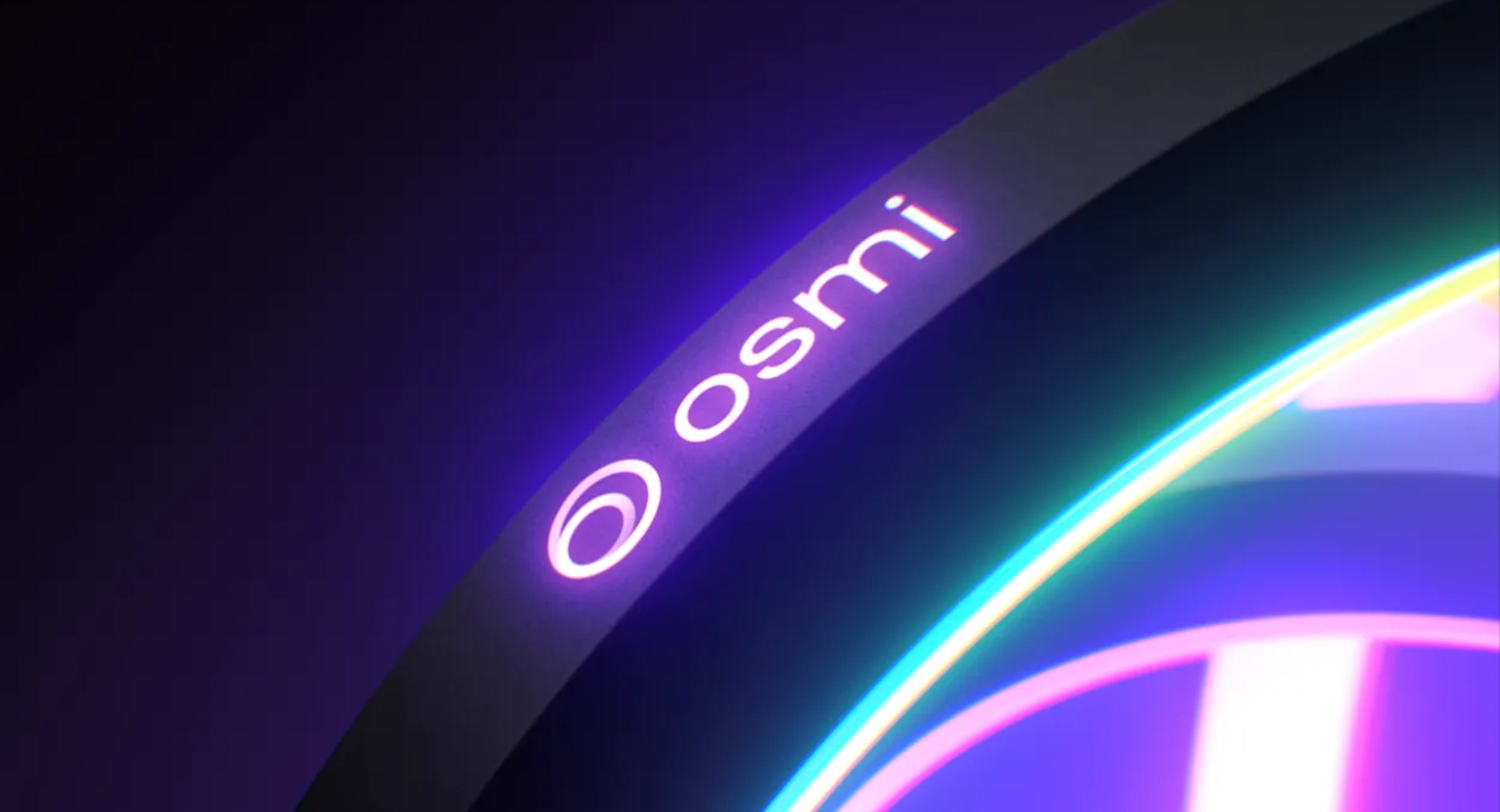
OSMI is "the first AI Assistant owned by the people," a decentralized AI chat platform running on a distributed network of GPU nodes contributed by operators worldwide. Tagline: "Decentralized, uncensored and open to all."
Instead of centralized servers controlled by one company, OSMI aggregates underutilized GPUs into a unified network. Node operators earn $OSMI token rewards for contributing compute. Users get an AI assistant that is decentralized, uncensored, and privately operated.
The product: OSMI Chat, with Truth Search (deep research mode), Think (sequential reasoning mode), image generation, and OSMI Trade for AI-assisted trading.
Founded in the USA by Chris Chuter. Working DePIN technology and a functional AI product when the project started. No market presence.
About the client
Industry
AI / DePIN / GPU Infrastructure
Stage
Pre-launch
Location
USA
My role
UX Lead, Art Director, Product Designer
Year
2024
Studio
Proof of Work Studio
Results
800%
token surge at TGE
1,000
nodes sold in under 5 hours
$1M
in tokens burned (all proceeds deflationary)
~6 days
operator payback period

Real product. No market presence. A landscape where decentralized AI didn't exist yet as a category.

The AI assistant market in 2024 was dominated by centralized platforms. ChatGPT, Claude, Gemini: all controlled by single companies with the ability to censor, bias, and restrict access. The decentralized alternative barely existed as a product category. DePIN node projects were mostly infrastructure abstractions: buy a node, earn tokens, wait for something to happen.
OSMI had a genuinely different proposition: an AI assistant that no single company controls, running on GPU compute contributed by its own community. The technology worked. The product was real. But no one knew OSMI existed, and the market had been burned enough times by DePIN vaporware that credibility was the first problem to solve.
The second problem: a dual audience. The node sale required converting crypto investors. The AI Chat required converting users who had never heard of decentralized AI. A site that works for one tends to alienate the other.
The third problem: product framing. Truth Search was deep research, not keyword lookup. Think was a visible reasoning process, not a fast answer. The decentralized architecture was a feature, not just a backend choice. Designing these required as much framing work as UX work.

Methodology

01
Competitor Analysis
Mapped the positioning of competing AI infrastructure and DePIN node sale projects. Three patterns emerged: pure infrastructure plays with no visible product; AI product plays with no visible infrastructure; node sale campaigns with no connection to the product. OSMI had all three components. The opportunity was to connect them coherently.
02
Sitemap: Dual-Audience Architecture
The marketing site had to serve two audiences without alienating either: crypto investors evaluating the node sale (care about tokenomics, network growth, reward mechanics) and AI users evaluating the product (care about model quality, features, and whether it beats alternatives). I designed the sitemap so each had a clear path through the site without being interrupted by content meant for the other.
Crypto investors: node sale section with tokenomics, roadmap, and reward mechanics
AI users: product section with features, capabilities, and access
Homepage: the bridge serving both
03
Wireframes with Functional Copy
All wireframes built with real copy. In a technical product with novel features, copy is architecture. A wireframe that says "headline here" cannot answer whether the page explains Truth Search to a first-time visitor. The wireframe pass resolved every content question before design began. Every page had a tested narrative before any UI work started.
04
Visual Concept and UI Design
POW Studio created the brand identity. I translated it into a site that felt like OSMI: technically serious, visually distinct. Dark backgrounds with precise technical typography, data visualization language in hero sections, interaction patterns borrowed from developer tools rather than marketing sites. The site was designed to signal: built by people who understand infrastructure. Full desktop and responsive UI across all marketing pages.
05
AI Chat: Full Product Design
Four distinct capability layers designed as one coherent product. Core chat: the default conversation interface, clean and fast. Image Generation: visual creation integrated into the chat flow, not a separate tool. Truth Search: deep research mode with visible progress states and source cards, designed so a 30-60 second process feels intentional, not broken. Think: sequential reasoning mode with collapsible thinking steps and prominent final answer. Multiple iterations per feature before reaching production.
Core chat: conversation interface
Image Generation: inline visual creation
Truth Search: deep research with source tracking
Think: sequential reasoning with visible process
06
Node Sale Checkout: Scarcity, Not Selection
There was no tier selection in the checkout. The active sale tier was set globally by marketing as a campaign trigger. The checkout did one thing: show which tier was currently active and how many licenses were left. That simplicity was the conversion mechanism. A buyer arrived, saw the current tier, saw the remaining count ticking down, and made one decision. No comparison tables, no package selector, no "which tier is right for me." The visible scarcity drove urgency. 1,000 licenses gone in under 5 hours.
07
Admin Panel for Node Owners
Node owners needed to understand what their investment was doing. License status, network contribution, reward tracking. Most node sale projects answer these questions with a Discord FAQ. I designed an admin panel that answered them in the interface. License management: visible, clear, actionable. The panel was designed as a product, not an admin screen.
08
Design System (Dual Architecture)
Two separate design systems. Marketing design system: components and tokens for the website, optimized for visual impact and brand expression. Product design system: components and patterns for the AI Chat and admin panel, optimized for usability and extensibility, built to support features that did not exist yet. Shared foundations where appropriate (color tokens, spacing scale), divergent component libraries where the contexts demanded it.
Marketing system: dark mode, editorial typography, large-format layouts
Product system: functional, extensible, feature-ready

Marketing site to product to node sale.

Two products designed in parallel: a marketing website to launch OSMI into the market, and an AI Chat product running on OSMI infrastructure. Plus the node sale infrastructure to fund it all.

Marketing Website
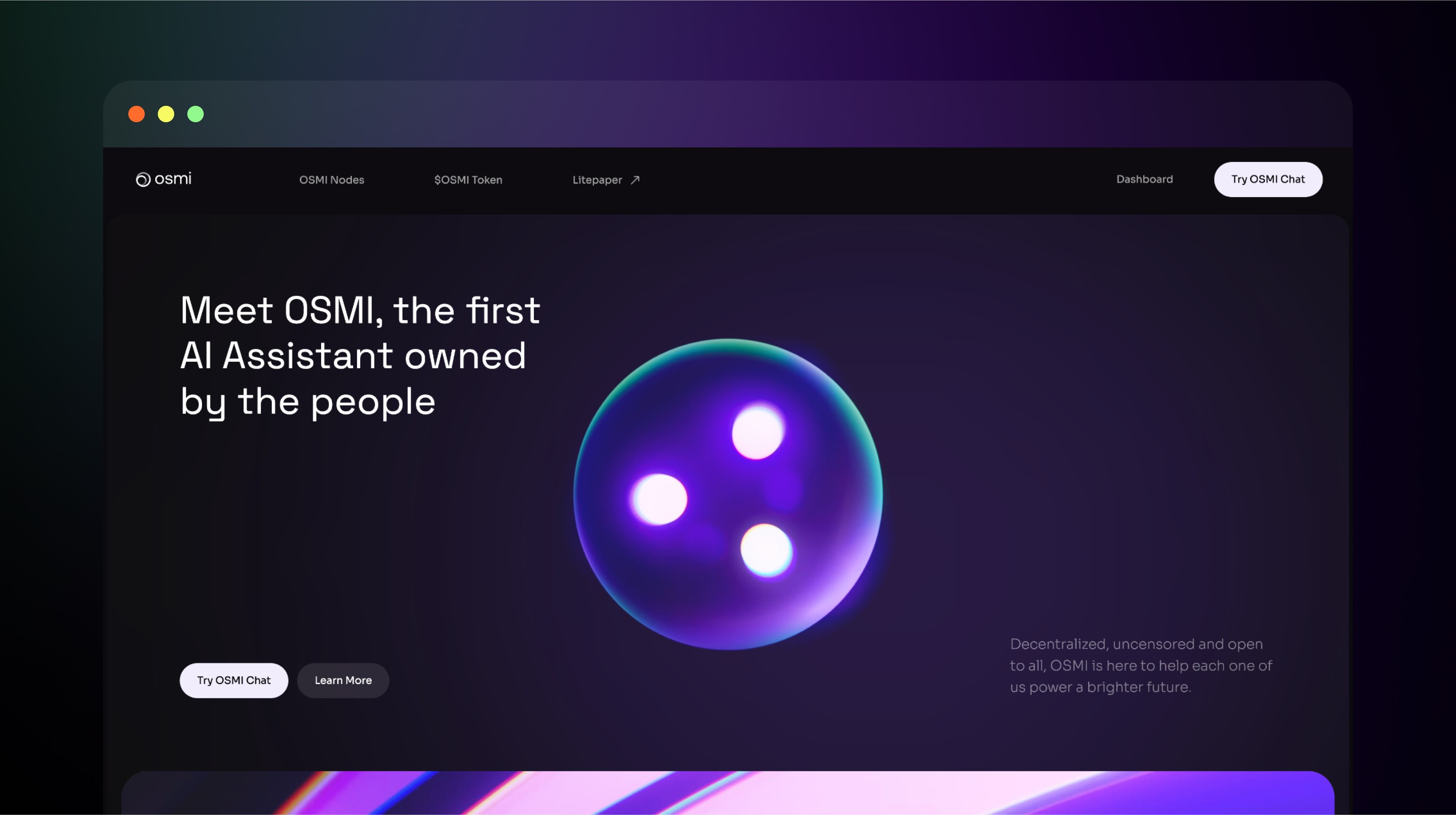
Full multi-page marketing site with competitor analysis, sitemap, wireframes with functional copy, visual concept, and complete UI. Two audiences served without either noticing the other. Crypto investors found their node sale path. AI users found their product path.
Marketing Website

AI Chat: Truth Search
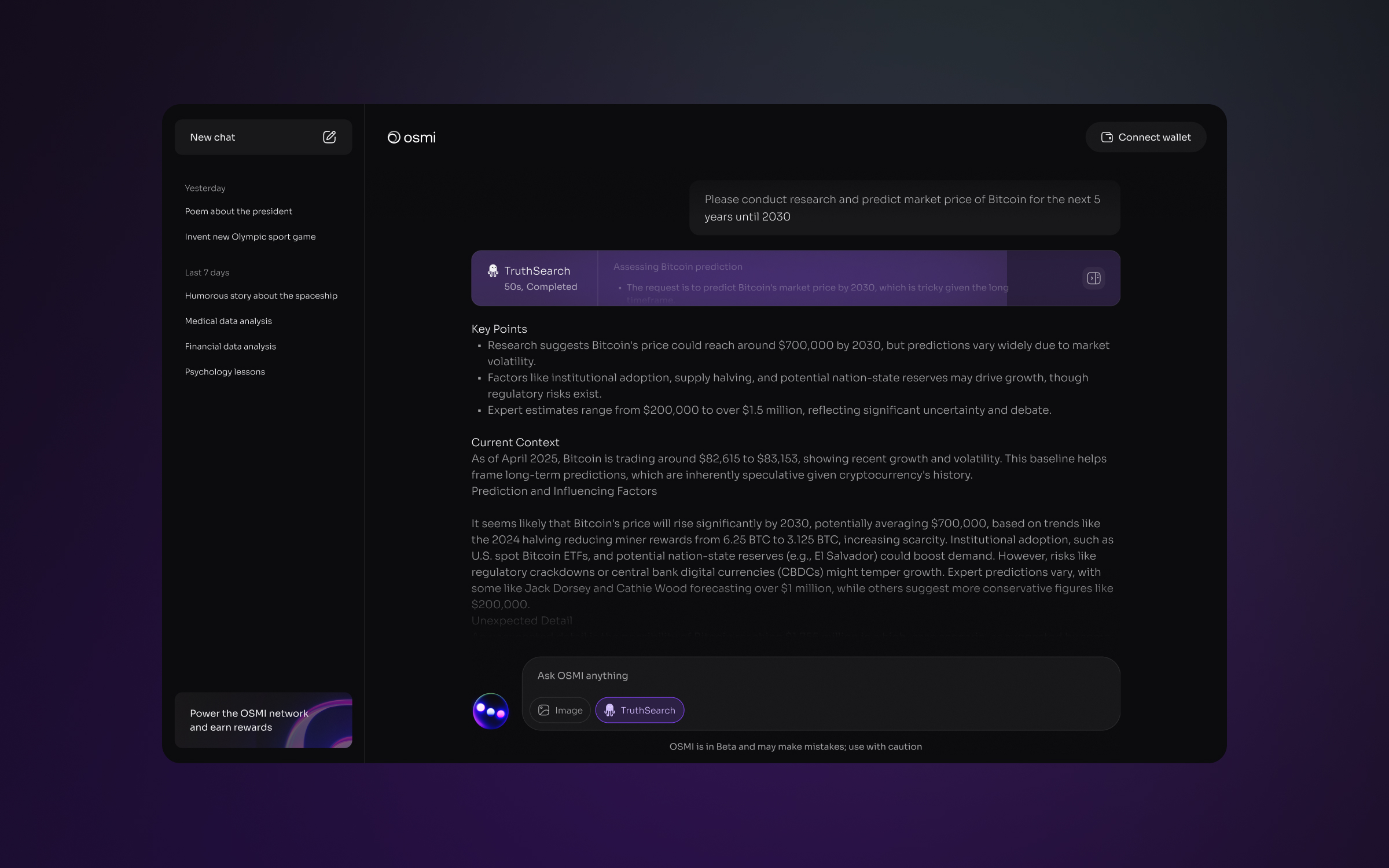
Deep research mode with visible progress states, source cards, and a distinct visual treatment. A 30-60 second process designed to feel intentional, not broken. The UX equivalent of showing your work.
AI Chat: Truth Search

AI Chat: Think + Image Generation
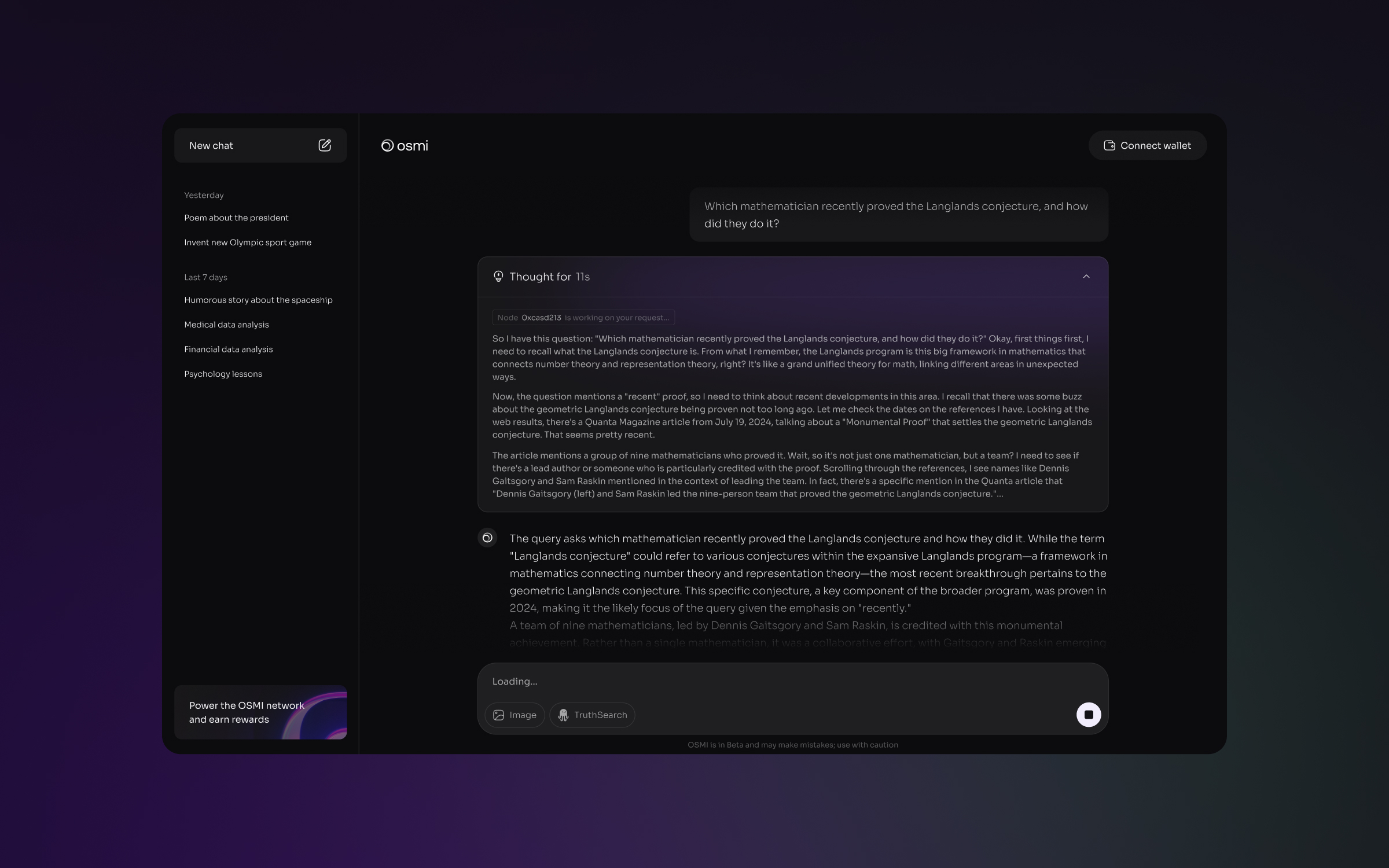
Think: sequential reasoning mode with collapsible thinking steps and prominent final answer. Image Generation: visual creation integrated into the chat flow, not a separate tool. Both features went through multiple iteration rounds before production.
AI Chat: Think + Image Generation

Node Sale Checkout
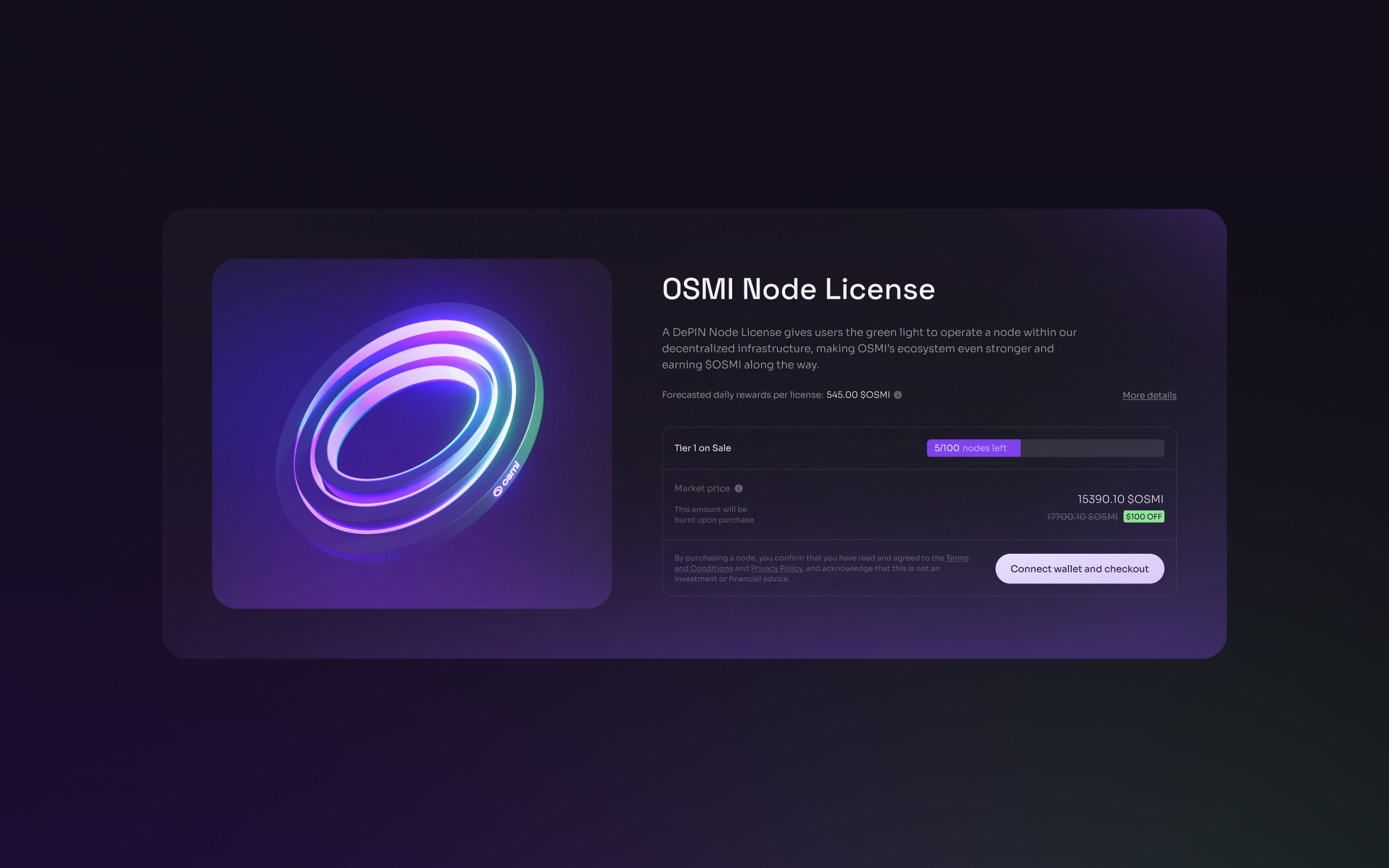
No tier selection in the checkout. The active sale tier was set globally by marketing as a campaign trigger. The checkout showed one thing: which tier was active and how many licenses remained. That single number was the conversion mechanism. Visible scarcity, one decision, no friction. 1,000 licenses sold in under 5 hours.
Node Sale Checkout

Admin Panel for Node Owners
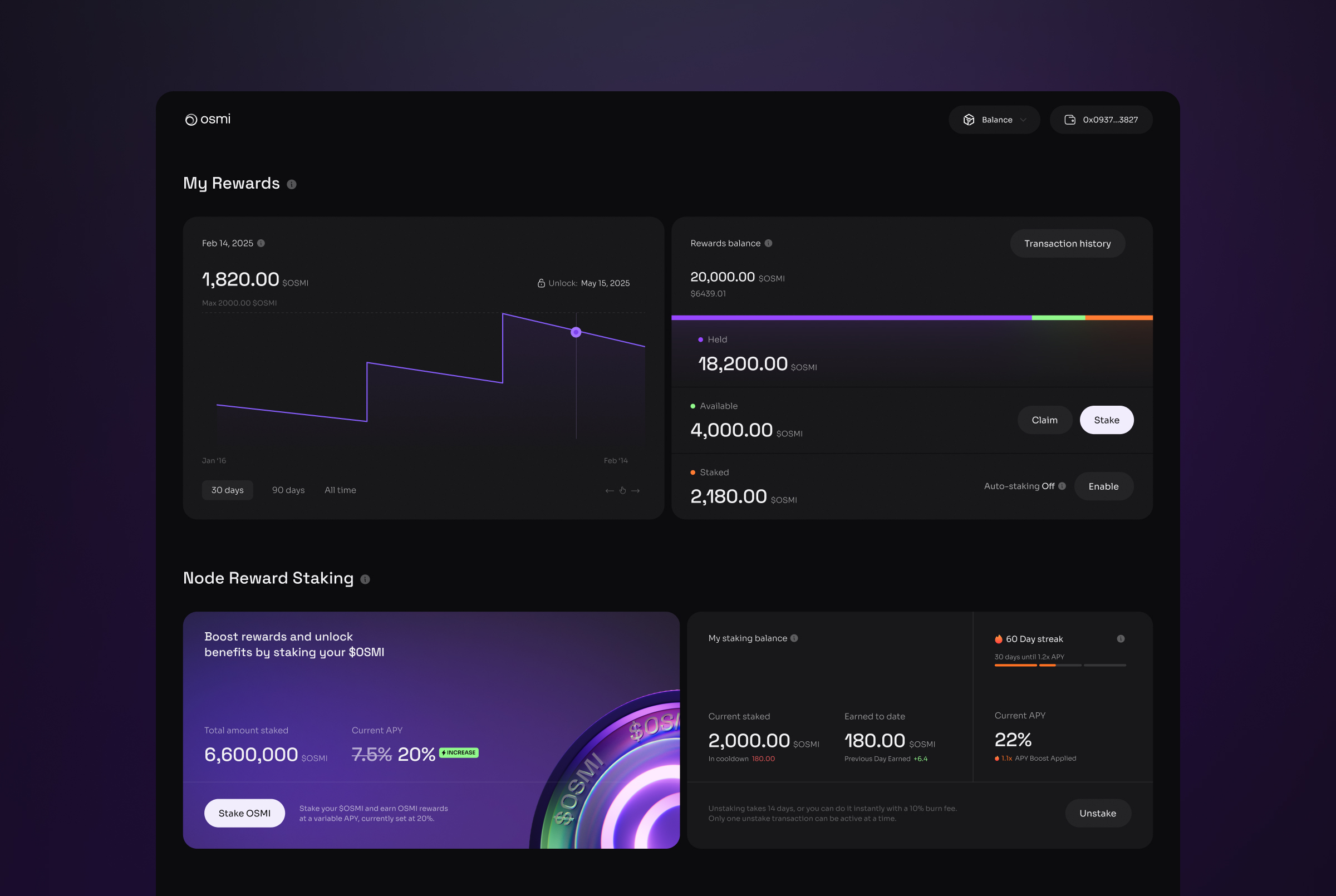
License management, network contribution tracking, reward status. Designed as a product, not an admin screen. Node owners could see what their investment was doing without leaving the interface or opening Discord.
Admin Panel for Node Owners

Design System (Dual)
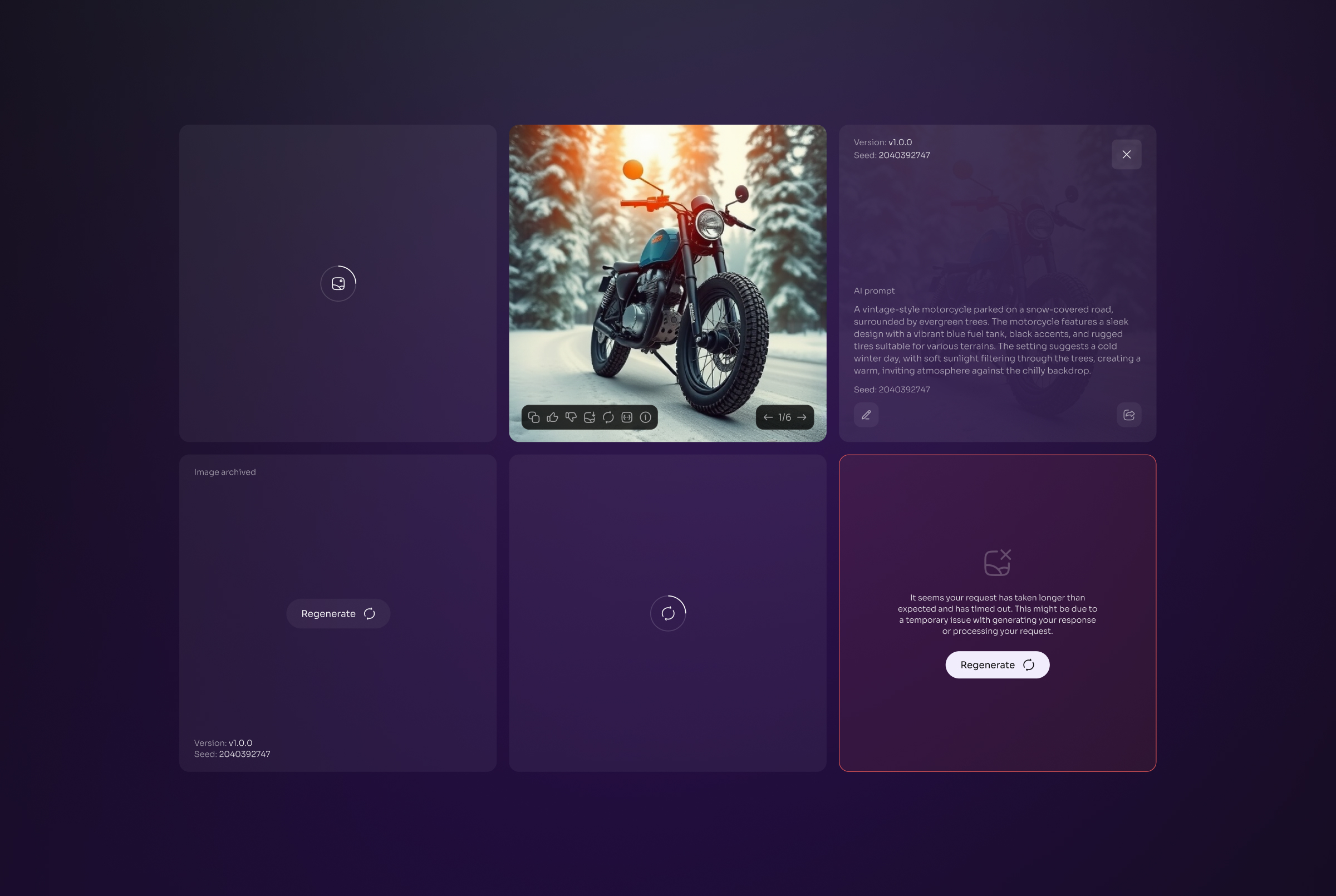
Two separate but related design systems: one for the marketing website, one for the AI Chat and admin panel. Shared color tokens and spacing scale. Divergent component libraries where the contexts demanded it. The product system was built for extensibility.
Design System (Dual)

1,000 nodes sold in under 5 hours. All proceeds burned.

November 25, 2024. Tier 1: 1,000 licenses at $1,000 each. Sold exclusively in $OSMI. All proceeds burned. Sold out in under 5 hours. Node operators earned 587 $OSMI per node in the first payout period. Estimated 6-day payback on their purchase. 800% token surge at TGE. The checkout showed one number: licenses remaining. That number did the selling.

Key achievements
01
1,000 node licenses sold in under 5 hours on November 25, 2024. Tier 1 price: $1,000 per license, sold exclusively in $OSMI. All proceeds burned.
02
800% token surge at TGE. Market responded to a coherent product narrative, not just speculation.
03
AI Chat designed with four features: core chat, image generation, Truth Search, and Think. Each with full interaction states and multiple iteration rounds.
04
Dual design system delivered: one for the marketing site, one for the product and admin panel. Built for extensibility, not just the current roadmap.
05
Two audiences served from one site without either noticing the other. Crypto investors and AI users had separate clear paths through the same information architecture.
800%
token surge at TGE
1,000
nodes sold in 5 hours
$1M
tokens burned
~6 days
operator payback period
"
The design team demonstrated exceptional professionalism, creativity, and reliability in developing the brand and website for osmi.ai. They delivered high-quality work on time and made the entire process enjoyable.
Chris Chuter
Founder, OSMI, OSMI

Strategic note

Most DePIN projects have a sequencing problem. They sell the node first, build the product later, and hope the community does not notice the gap.
OSMI had the product. The GPU network was real. The AI Chat was real. Truth Search and Think were real features, not roadmap items. The problem was not that the product did not exist. It was that no one knew it existed, and the market had been burned enough times by projects making identical claims with nothing behind them.
The design work on this project was fundamentally a trust-building exercise. Every surface, from the marketing site to the checkout to the admin panel, had to signal: this is real, this works, this is worth your capital.
The node sale sold out in under five hours. That is not a conversion rate. That is a verdict on whether the design succeeded at making something real feel real.
Dmitry Chernov
Dmitry Chernov
Web & Product Architect / AI, SaaS & Web3
Let's talk about your website
Free 30-minute call. No commitment. I'll share 2–3 observations about your site before we discuss anything else.
More case studies

Your website has problems you can't see. I'll find them for you.

Free 30-minute call. No commitment. I'll share 2–3 observations about your site before we discuss anything else.

Dmitry Chernov
Web & Product Architect AI, SaaS & Web3
© 2026 Dmitry Chernov. All rights reserved.
Privacy policy Terms and conditions