← All writing
Website Audit
Positioning
Stripe's hero headline and what changed
Stripe's 2015 headline was widely cited as a B2B positioning benchmark. The current version makes different choices. Three things worth examining when comparing the two.
May 2026
/
4 min read
Overview
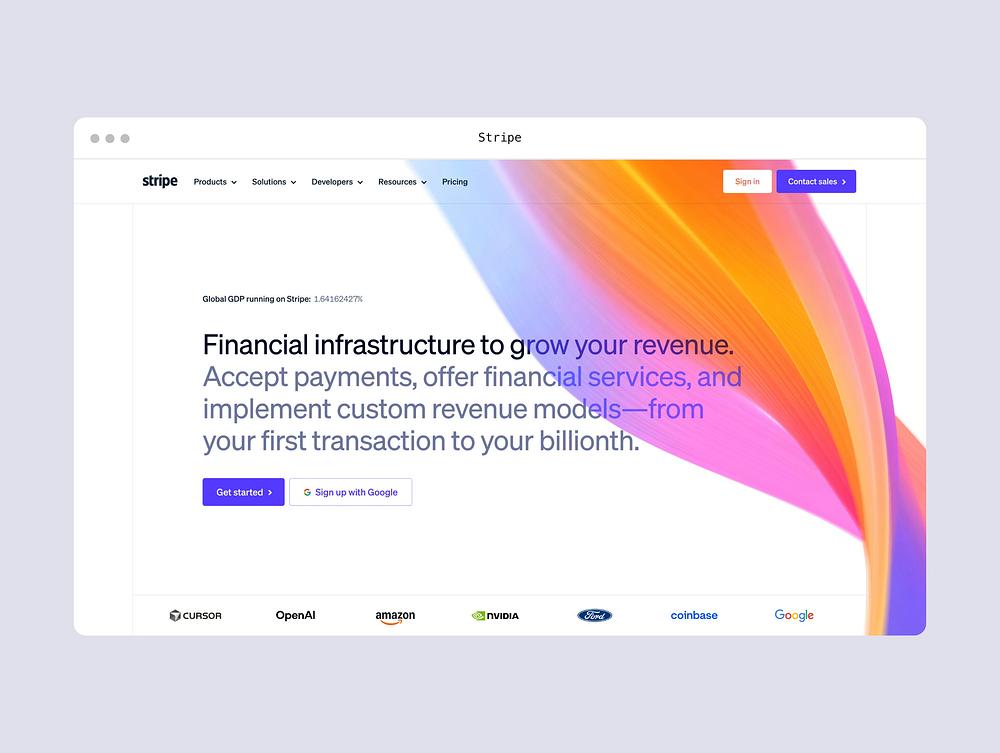
Stripe's 2015 homepage headline is still widely referenced in positioning and copywriting circles: "Financial infrastructure for the internet." Seven words, precise category, implicit scale. In May 2026, the headline on stripe.com reads: "Financial infrastructure to grow your revenue. Accept payments, offer financial services, and implement custom revenue models from your first transaction to your billionth." I've been looking at this change as part of a broader audit of B2B hero sections, and wanted to write up what I observed.
What made the original strong
"Financial infrastructure for the internet" worked on several levels at once. It named the category clearly, defined the audience by platform rather than by industry vertical, and implied global scale without stating it explicitly. The phrase also created a useful mental shortcut: if you build something on the internet that moves money, Stripe is the infrastructure layer. That kind of clarity is hard to arrive at and easy to move away from. The line became a benchmark because it earned it through specificity.
What is different about the current version
The current headline makes three moves that are worth examining. The opening phrase "financial infrastructure to grow your revenue" positions Stripe alongside any payment infrastructure provider. Adyen, Checkout.com, and Worldpay operate in the same category and could use similar language. The 2015 version had a specific anchor ("for the internet") that reflected something genuinely distinctive about Stripe's early positioning and customer base. The second shift is in the subheadline. Listing three product lines communicates that Stripe has expanded significantly, which is true and worth communicating. But it may leave a buyer doing more work to identify which part applies to them. The third observation is about what is not in the current headline: Stripe's unified platform. They cover payments, billing, tax, fraud prevention, and payouts through a single API. That level of coverage in one platform is uncommon in the industry.
Why this happens at scale
This is not unique to Stripe. As B2B products grow, their audience expands and the messaging naturally tries to reflect that. A headline written for a focused early customer base gets revisited when the product serves ten different segments. Each revision tends to add breadth and remove specificity, not because the team is making a mistake, but because the product genuinely covers more ground and the messaging is trying to keep up. The result is often copy that is accurate and inclusive but harder to grab onto. It is a genuinely difficult tradeoff to navigate.
What a stronger version could look like
If I were exploring directions for the hero, two angles seem worth trying.
Option 1: Return to the original anchor.
"Financial infrastructure for the internet."
One API for payments, billing, tax, and payouts. Trusted by 50% of the Fortune 100, 78% of the Forbes AI 50, and millions of growing businesses.
The original line already did the hardest work: it named the category in a way that was specific to Stripe's position. Updating the subheadline to surface the platform coverage and the trust proof would close the gaps in the current version without abandoning what made the original strong.
Option 2: Lead with the unified platform (recommended direction).
"One API for payments, billing, tax, and payouts."
Stripe replaces the multi-vendor stack with one financial platform. Used by Hertz, Shopify, OpenAI, and 50% of the Fortune 100.
This surfaces the technical moat directly. No competitor covers payments, billing, tax, fraud, and payouts in a single API at Stripe's scale. A CFO or CTO evaluating infrastructure options would find the claim immediately useful. It also names the real alternative being displaced: the multi-vendor stack. That is how finance teams actually frame the decision.
Of the two, Option 2 makes a more differentiated claim. Option 1 has the advantage of resonance: it returns a line the market already recognises.
Whatever direction, some patterns tend to weaken hero copy rather than strengthen it. Words like innovate, transform, revolutionize, and next-generation add noise without adding information. Abstract metaphors ("the rails of commerce", "the operating system for money") are harder to evaluate than concrete claims. Headlines longer than eight words and subheadlines longer than two sentences tend to lose the reader before the message lands. The underlying principle: a good hero section reduces uncertainty rather than trying to inspire. The current version leans toward inspiration.
Whether either option fits where Stripe is taking the product is something only their team would know. The point is not to prescribe a solution but to surface the specific claim that is currently underused.
A question worth asking about your own headline
Read your hero headline and remove your company name and logo. Could a direct competitor say the same thing without it being false? If yes, it may be worth exploring whether there is a more specific claim available. That claim is usually somewhere in the product already. It tends to appear in sales calls, in the language customers use to describe the product, or in a feature that competitors have not matched. Getting it into the first line is often the highest-leverage copy change available.
If you want a second opinion on your hero section, I cover positioning and headline clarity in website audits. The first observations come before we discuss anything else.
Author
Dmitry Chernov
/
Web & Product Architect
Keep reading
Audit notes
Website Audit
Conversion
You're fixing the wrong layer. That's why your site keeps losing buyers.
May 2026
/
5 min read
.jpg)
Thoughts
AI Design
Product Design
AI replaced one type of designer and amplified two others.
Apr 2026
/
2 min read
.jpg)
Thoughts
AI Design
Product Strategy
AI can't build your product. It can only execute your thinking.
Apr 2026
/
5 min read
.jpg)
Audit notes
UX Design
Web3
$50M lost. Because of bad UX.
Mar 2026
/
2 min read

Your website has problems you can't see. I'll find them for you.
Free 30-minute call. No commitment. I'll share 2–3 observations about your site before we discuss anything else.
Your website has problems you can't see. I'll find them for you.
Free 30-minute call. No commitment. I'll share 2–3 observations about your site before we discuss anything else.
Your website has problems you can't see. I'll find them for you.
Free 30-minute call. No commitment. I'll share 2–3 observations about your site before we discuss anything else.

© 2026 Dmitry Chernov. All rights reserved.
© 2026 Dmitry Chernov. All rights reserved.
© 2026 Dmitry Chernov. All rights reserved.